What Is Copywriting? How to Write Words That Actually Grow Your Business
Most small business owners spend thousands on their website design and almost zero time on the words.
Which is wild…because the words are the part that actually makes people buy.
And it's not just your website. It's your social media posts, emails, ads, even the way you describe what you do at a networking event. Every time you write or speak for your business, you're using copywriting—whether you realize it or not.
So what is copywriting, exactly? And how do you make sure yours is actually working?
This guide will walk you through everything you need to know (in plain English) so you can start using this skill to grow your business.
Here's what we'll cover:
What copywriting actually means (and why it's not as "salesy" as it sounds)
Where copywriting shows up in your business
Why your words matter more than you think (with real examples)
Signs your copy needs work
Copywriting vs. content writing — what you actually need
The truth about using AI for your copy
DIY tips if you're doing it yourself
How to hire a pro (and what to watch out for)
A 15-minute website audit you can do right now
Let's get into it.
What Is Copywriting? (And Why It's Not as "Salesy" as You Think)
Copywriting is the skill of writing words that persuade someone to take action — buy a product, book a service, sign up for a list, click a link. It shows up everywhere in your business: your website, emails, ads, social media, and more. It's how you make your words sell for you, even when you're not in the room.
I also like the classic definition: "salesmanship in print." That phrase has been around for 100 years, and it's not wrong.
But I get why it makes some business owners uncomfortable. "Salesmanship" can sound pushy or manipulative. Like copywriting is about tricking people into buying something they don't need.
It's not.
Here's how I think about it. We all need to sell to grow. You can sell person-to-person — knocking on doors, attending every networking event, doing all the talking yourself. You can hire more salespeople. Or you can learn to make your words do the selling for you.
And let’s talk about "persuasion" for a second. It's not about creating a desire that doesn't exist. It's about tapping into a desire your customer already has and showing them why your business achieves it.
It has to be genuine, or else you're tricking someone. That's not good marketing, and it doesn't last.
Good copywriting is honest. It just happens to also be strategic.
Copywriting vs. Copyright (Quick Clarification)
Before we go further — this trips people up all the time, so let's clear it up.
Copywriting (one word) is writing persuasive words for your business. Copyright (also one word) is legal protection for creative works like books, music, and art.
Totally different things. Now back to the one that'll help you grow your business.
Where Copywriting Shows Up in Your Business
Most people hear "copywriting" and think of catchy slogans or big ad campaigns. But for a small business owner, it shows up in way more places than that.
Basically, anywhere your words represent your business — that's copywriting.
Here's what I mean:
Your website homepage — the first impression for most of your customers
Your service or product pages — where people decide to buy or leave
Your Google and social media ads — the few words that determine whether someone clicks
Your social media posts and captions — how you build trust and stay top of mind
Your emails — welcome sequences, promotions, follow-ups
Your Google Business profile — your description in local search results
Your proposals and quotes — the words that close (or lose) the deal
Your voicemail greeting — seriously, even that
The truth is, you're already doing copywriting. Every time you write a social post, send a quote, or update your website, you're writing copy.
The question isn't whether you do it. The question is whether you're doing it well.
And doing it well matters more than most business owners realize.
Why the Words on Your Website Matter More Than You Think
Let me show you with some quick math.
Say 1,000 people visit your website each month. If 1% of those visitors “convert” or buy from you, that's 10 new customers.
Now imagine you improve the copy on your site and that conversion rate goes from 1% to 2%. That's 20 customers. You’ve doubled the results without spending an extra dollar on ads.
At the same time, you could improve the hooks on your short-form videos, and drive 5,000 people to your website instead of 1,000. If you still convert 2% of that audience, now you’ve got 100 customers.
That's the power of copywriting.
What Happens When You Get the Words Right
I worked with a client who sells tumblers in bulk for customization — laser engraving, custom printing, that sort of thing. When I started, a lot of their website content was product-focused. "How to engrave a tumbler." "Reasons to buy a tumbler."
Technically accurate. But completely missing what their customer actually wanted.
I found out through spending time with their audience that their customers weren't searching for tumblers. They were searching for how to grow a business and make money doing what they love. The tumbler was just the tool.
So I shifted the content strategy. We talked less about the product and started speaking to the customer's real desire.
The result? The blog grew from zero to 25,000 monthly organic visits and built a community around their brand instead of just pushing products.
Here's another one. I wrote a sales email for a fitness coach who was launching a $3,000 coaching package for women over 50.
It wasn’t a hard sell. Instead, the email told the coach's personal story — growing up watching his mom and aunt struggle with weight and health issues, his own breakthrough, and his mission to help other women avoid the same pain.
It ended with a simple invitation to sign up for the new coaching package.
In a cold launch and a small list, three people signed up, making $9,000 in sales from one email.
Signs Your Business Has a Copywriting Problem
In my estimation, at least half of small business online are focused on the business instead of the customer. If any of these sound familiar, you're in good company — and it's completely fixable.
Here are the signs:
Your homepage headline describes what you do, but doesn't mention what the customer gets.
Your "About" page is all about your company history, awards, and credentials — and barely mentions the people you serve.
Your calls to action say "Click Here" or "Learn More" instead of telling people exactly what happens next.
People visit your site but leave in seconds without taking action.
Your emails get opened, but nobody clicks.
Your ads get clicks, but nobody buys once they land on your page.
And maybe the biggest tell: your copy could belong to any business in your industry. Nothing about it is specific to YOU.
A Real Example
Let me show you what this looks like in the wild.
I found this website for Kibble Pet Grooming in Texas. Looks like an awesome business really helping people. But if I was working for them, I’d improve their website copy.
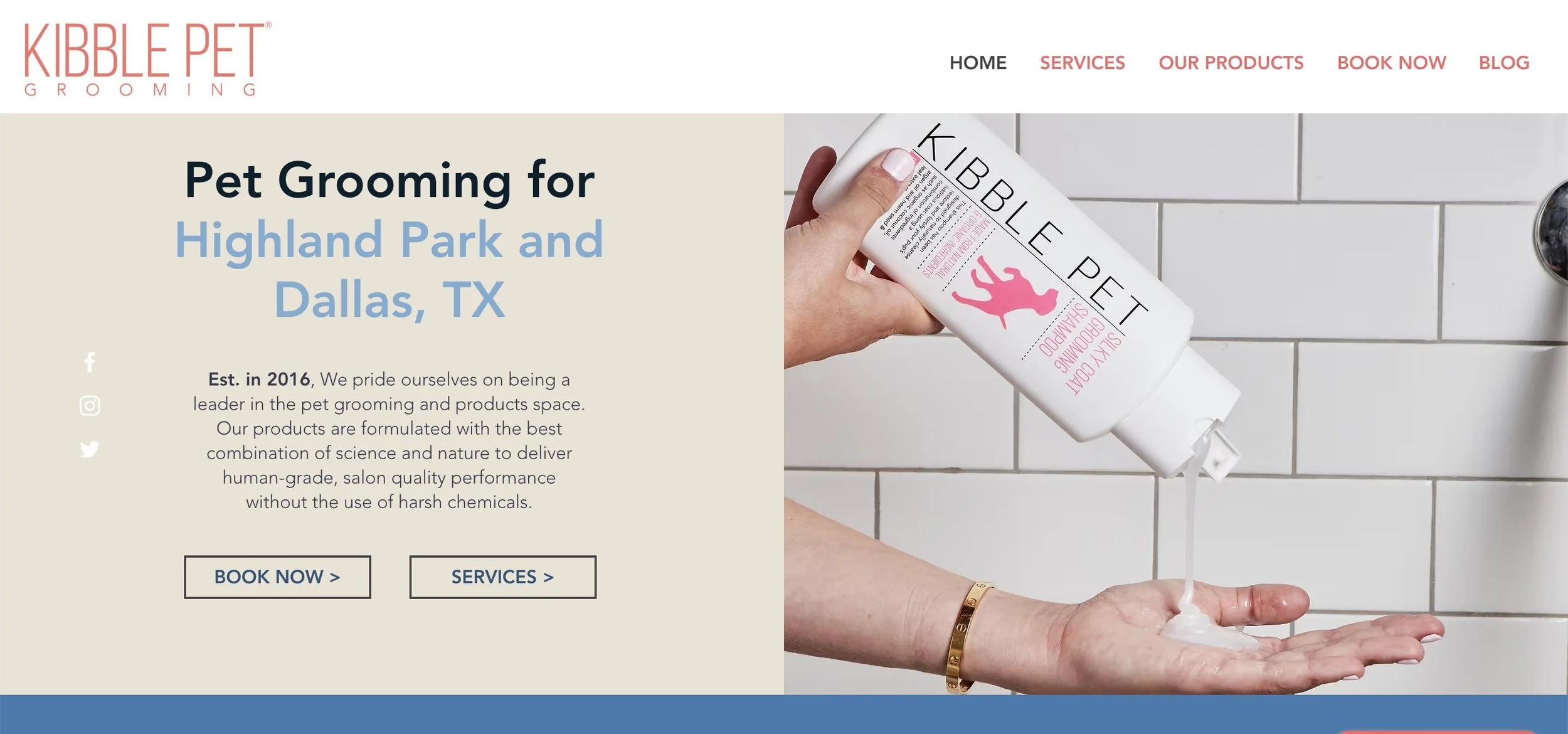
Their headline reads: "Pet Grooming for Highland Park and Dallas, TX." And the body copy starts with: "We pride ourselves on being a leader..."
Everything here is about the business. Not much about what the customer wants. It’s clear and accurate, but not compelling for the pet owner visiting the site.
Here’s how I’d re-work it:
A photo of a happy, clean dog with their happy owner. A headline that reads something like: "Keep your dog healthy and happy without yucky chemicals." And the location info in a subtitle so it's still there for SEO.
Take a look at your own homepage. Does it sound more like the before or the after?
Copywriting vs. Content Writing: What Kind of Writer Do You Actually Need?
You've may have heard that copywriting is for persuasion (getting people to buy) and content writing is for education (blog posts, articles, social content that builds trust over time).
That distinction is technically true. But it can lead you to a wrong conclusion.
Some people will tell you to hire a copywriter for your sales pages and a separate content writer for your blog and social media. I disagree.
Copywriting isn't a separate type of writing. It should be woven into everything you write.
A blog post without persuasive writing is just information sitting on a page. An email without a compelling hook gets deleted. A social media post without a reason to engage gets scrolled past.
Don't work with any content writer who doesn't understand how to weave copywriting into the content. Copywriting is a must if you want your content to perform.
So when you're hiring, don't ask "Do I need a copywriter or a content writer?" Ask: "Does this writer understand persuasion?"
Can’t I Just Use AI for My Copywriting?
This is the question every small business owner is asking right now. And the honest answer is: it depends.
AI writing tools are everywhere. The vast majority of marketers and business owners are using them in some form. And I wouldn’t tell you to avoid them completely.
Here's where AI can genuinely help:
Getting past a blank page (first drafts of almost anything)
Social media post ideas and captions
Product descriptions when you have dozens of items
Email templates you can customize
Brainstorming headlines or angles
But here's where it’s not so great.
AI is a pattern-matching calculator. It takes everything that's already been written and gives you the average. And by definition, the average can't be distinctive.
That's why AI-generated copy defaults to phrases like "your trusted partner," "tailored solutions," and "take it to the next level." Those phrases could belong to literally any business on earth. They don't say anything specific about what makes YOUR business different.
AI copy is flat. It lacks human connection, personal stories, and the specific details that make people actually trust you enough to buy.
And here's the irony: to get good copy out of AI, you need to already know your angle, your positioning, and what your customer needs. In other words, you need copywriting skills to use AI well.
My recommendation:
Use AI for first drafts and lower-stakes content. Don't rely on it for your homepage, sales pages, or any high-stakes conversion copy. Always have a human — you or a professional—review and add the specific, personal, emotional elements AI can't generate.
According to chatter I see on LinkedIn, businesses that fully replaced human copywriters with AI have seen their conversion rates decline — and many are bringing experienced writers back at higher rates than before.
DIY Copywriting Tips (If You're Doing It Yourself)
You don't need a marketing degree to write better copy. But you do need a starting point.
Here are the fundamentals that'll improve everything you write.
1. Start with the 5 Marketing Questions
Before you write a single word of copy, answer these five questions:
Who is your target customer?
What do you sell, and how does it make their life better?
What outcome does your customer really want that your product helps them achieve?
What do they want to avoid that your product saves them from?
How can you communicate that?
These questions are the foundation of all good copy. Every headline, email, and social post should tie back to your answers.
(I go into more detail on this in my article explaining what is marketing. If you haven't read it yet, start there.)
2. Talk to Your Customers (and Borrow Their Words)
The best copy reflects what your customer is already thinking and feeling — in their own words.
Talk to your actual customers. Ask them: What problem were you trying to solve? What almost stopped you from buying? Why did you choose us over someone else?
Then use their exact language in your copy.
If they say "I was sick of feeling lost," don't rewrite it as "navigating challenges in an uncertain landscape." Use the words verbatim. This is how good copy is made.
Can't talk to customers yet? Mine real customer language from Amazon book reviews in your niche, YouTube comments, and Reddit posts. People are brutally honest in those places. The words they use to describe their problems are gold for your copy.
3. Learn a Framework
Two classic copywriting frameworks that are great starting points:
AIDA — Attention, Interest, Desire, Action. Grab their attention, build interest, create desire for what you offer, then tell them what to do next.
PAS — Problem, Agitate, Solution. Name the problem, make them feel why it matters (agitate), then present your solution.
These give you a structure so you're not staring at a blank page wondering where to start.
4. Clear Beats Clever
The copy that drives the most revenue for small businesses isn't flashy or clever. It's clear, specific, and empathetic.
Say exactly what you do, who it's for, and what the customer gets. Don't try to be cute with vague taglines or trendy buzzwords. If someone lands on your homepage and can't figure out what you do within five seconds, you've lost them.
5. Cut the Fluff
Every sentence should move the reader forward. If it doesn't, cut it.
If you want to sharpen your writing, pick up a copy of The Elements of Style by Strunk and White. It's short, it's been around forever, and it will make everything you write tighter and clearer.
When to Hire a Copywriter (and How to Find a Good One)
At some point, you might decide you want professional help. Maybe your website needs a complete overhaul, or you're launching something new and the stakes are high, or you just don't have time to do it yourself.
Here's how to find someone good (and how to spot someone who isn't).
Copywriter Green Flags
They listen before they pitch. A good copywriter takes time to understand your business, your customers, and your goals before suggesting anything.
They understand you. After getting to know your business, a good copywriter should be able to repeat back to you who your customer is, what their deepest desire is, and how your products help them achieve it. If they can't do that, they haven't done their homework.
They don't push their ideas on you. They honor your intuition — you know your business best. They listen to your ideas and find flexible solutions.
They can explain the "why." Any good copywriter should be able to tell you why they want to use a certain approach, not just what they want to do.
They measure results. They're prepared to track performance and report on numbers. They can trace their strategy back to real outcomes.
Copywriter Red Flags
They skip the listening phase and jump straight to telling you what you "need."
They have one playbook for everyone — one tactic they use for every client, and they try to squeeze you into it. This may work when you’re a large business, but for now, you need someone who can do it all for you.
They can't explain their choices. If you ask "why this approach?" and they don't have a clear answer, that's a problem.
Their own writing is bland. If their portfolio or website copy isn't compelling and easy to read... that tells you something.
What Does a Copywriter Cost?
Before I give you numbers, let me share a concept that changed how I think about pricing:
Price is a risk transfer.
When you pay more for a copywriter, you're putting the risk on them — they need to deliver. They have the experience, the process, and the motivation to make it work.
When you pay less, you're absorbing the risk yourself. You don't know if they'll deliver, and if they don't, you'll be the one cleaning it up. A cheaper writer also likely won't have the time or resources for deep audience research and genuinely creative ideas.
That doesn't mean you need to spend a fortune. But it's worth thinking about who's bearing the risk of this working.
Here are some general market ranges to give you an idea (these vary by experience, industry, and scope):
Social media posts: $20–$100 per post
Blog posts (quality, ~1,000 words): $150–$500
Email sequences: $100–$500 per email
Website copy (full site, 5–7 pages): $1,500–$7,000+
Sales or landing pages: $500–$5,000+
Hourly rates: Junior $25–$75/hr, Mid-level $75–$150/hr, Senior $150–$300+/hr
Wide ranges, I know. But the "Price = Risk Transfer" frame is the most useful lens for deciding what to invest.
Your 15-Minute Website Copywriting Audit
Alright, here's where we get practical.
Grab your phone or open your laptop. Pull up your website homepage. This will take 15 minutes, but it might be the most useful 15 minutes you spend on your marketing this month.
Go through this checklist:
1. Is your homepage focused on the customer, not on your business? Read your headline and first few sentences. Who's the main character? If your first instinct is to talk about your company, your history, or your credentials... flip it.
2. Does your headline mention your customer's problem or desired outcome? Not just your business name. Not just what you do. What does your customer get?
3. Is your main call to action visible before scrolling? "Book Now," "Get a Quote," "Shop" — whatever your main action is, it should be right there at the top of the page. And it should be in your navigation bar, too.
4. Are you using your customer's language? Read your copy out loud. Does it sound like the way your customers actually talk about their problems? Or does it sound like corporate filler that could belong to anyone?
5. Are you showing them the "after"? Do your words and images paint a picture of your customer's life after they buy from you or work with you? (People buy outcomes, not products.)
6. Do your CTAs tell people exactly what happens next? "Get a Quote" or “Shop Candles” beats "Learn More" every single time. Be specific.
7. Are you describing benefits, not just features? Features are what it is. Benefits are what it does for them. "Our software has real-time syncing" is a feature. "Never lose a document again" is a benefit.
8. Is there social proof on your key pages? Testimonials, reviews, client logos, case studies—anything that shows real people trust you.
Questions About Copywriting
What is the difference between copywriting and copyright? Copywriting is writing persuasive words for your business—website copy, emails, ads, and more. Copyright is the legal protection that covers creative works like books, music, and art.
What is the difference between copywriting and content writing? The traditional distinction is that copywriting persuades (sales pages, ads) while content writing educates (blogs, articles). But in my experience, the best content does both. Any writer you hire should understand how to weave persuasion into their content — it's not either/or.
How much does a copywriter cost? It varies widely depending on experience and project scope. Website copy for a full site might run $1,500–$7,000+, while a single blog post could be $150–$500. Think of pricing as a risk transfer—higher investment means the copywriter bears more responsibility for delivering results.
Can I do copywriting myself? Yes—and learning the basics will make you a better business owner even if you eventually hire someone. Start with the 5 Marketing Questions in this article, talk to your customers, and focus on being clear and specific rather than clever.
Can AI replace copywriting? AI is useful for first drafts and lower-stakes content like social media posts and product descriptions. But it can't replace human copywriting for high-stakes pages like your homepage or sales pages. AI produces the average of everything already written—which by definition can't be distinctive. You'll always need a human to add the personal, specific, emotional elements that make people trust your business.
How do I know if my copy is bad? The fastest test: read your homepage and count how many times it says "we" vs. "you." If it's mostly about your business rather than your customer, that's your sign. Other red flags: vague CTAs like "Learn More," high bounce rates, and copy that could belong to any competitor in your space.
What should I look for when hiring a copywriter? The biggest green flag: they listen first. After learning about your business, a good copywriter should be able to tell you who your customer is, what they want, and how your product helps them get it. If they skip the listening phase and jump straight to tactics, keep looking.
What kind of results should I expect from professional copywriting? It depends on the project, but consider this: improving your website's conversion rate from 1% to 2% doubles your customers from the same traffic. Good copy also compounds over time — a well-written blog post or sales page keeps working for months or years. The key is finding a copywriter who measures results, not just delivers words.
Your Next Step
Now that you know what copywriting is and how it works, start looking at your business with fresh eyes.
Where are people dropping off? Where are you talking about yourself instead of your customer? Where could stronger words move someone from "just browsing" to actually buying?
Maybe it's your homepage headline. Maybe it's your email subject lines. Maybe it's the way you describe your services on a proposal.
Pick one thing. Rewrite it with your customer's desire front and center. See what happens.
One small change at a time adds up faster than you'd think.
And if you'd rather hand it off to someone who does this every day. I'd love to help. I work with small businesses to write copy that actually sounds like them and gets results. I offer afree strategy session where we look at what you've got, talk through your goals, and figure out the best next step for your business.